Video Games as Literature: Essays by Kirsten Rodning: Arthurian Literature

Showing posts with label Arthurian Literature. Show all posts

Video Games as Literature 101: MomoCon 2024 Panel

Banner that says "MomoCon 2024: Video Games as Literature 101."


Last month was MomoCon 2024 in Atlanta, GA, and for the first time I presented two panels in one day! This was exhausting, so I must apologize because it took me about a month to get videos of my panels uploaded. My first panel was Video Games as Literature 101, and the video for that panel can be viewed below. I received many thoughtful questions at this panel, and due to my fatigue I may not have given the most thorough answers in the moment, so I wanted to add some extended answers to the Q & A here in this blog post. I hope this helps!


Note: The links on each question will lead you to the specific part of the video where the question is asked.

A: Yes, and here is the post about Shadow of the Colossus that I referenced in my answer to this question during the panel: Shadow of the Colossus. And here is a link to some more information on the Hideo Kojima documentary I referenced: Hideo Kojima: Connecting Worlds.

A: Absolutely, though I would advise everyone to keep in mind that most western fantasy stories -- and even non-fantasy stories -- have some aspect of Arthurian influence in them as the Arthurian legends are considered the most influential literature of Great Britain (in fact, the entire Arthurian canon is often referred to as "The Matter of Britain.") This influence has spread to much of the world through Great Britain's colonization. I do see a lot of influence specifically from the British Isles in the Dragon Age series, however, and not only is King Arthur a strong influence, but Celtic mythology is specifically noticeable in Dragon Age. If you want to read more scholarly literature on the Dragon Age series, here is a link to a WorldCat search on the subject. The books I recommend to start learning about Arthurian Literature include The Once and Future King and The Crystal Cave. 

A: These games are historical fiction as they are fictionalized versions of real time periods, and occasionally real events. Call of Duty is a tricky game to discuss in terms of historical depictions, as the series has been called out for revising history in its depictions of war -- especially when it comes to depictions of The United States and their actions in certain conflicts. The Assassin's Creed series is known (especially in more recent games in the series) for its extreme accuracy in terms of historical and architectural depictions. The Assassin's Creed games, ultimately, are still fiction, especially as they usually feature made-up characters and mythological encounters. Sid Meier's Civilization games can also teach you a lot about history, but they tend to crunch a lot of historical events together in the timeline for gameplay value, so take anything you learn from those games with a grain of salt.

I also mentioned "archaeogaming" in the panel, and the archeological study of Assassin's Creed and Tomb Raider games, specifically. You can learn more about archaeogaming here. 

A: There are so many cultures in the world with so much diverse folklore that in my short life I haven't had a chance to study them all. I am so happy to hear people interested in folklore that isn't the usual English, French, or German fare that we usually read about in the west, though! In my panel I recommended the Persona series, and by extension the Shin Megami Tensei franchise, as those games incorporate folklore and myths from a large variety of sources. Wikipedia says that, "the series has incorporated elements of Gnosticism, various world mythologies and religions including Christianity and Buddhism, early science fiction, Jungian psychology and archetypes, occultism, punk, and cyberpunk." (Source) Welsh folklore, specifically, has trickled down over the centuries into the general folklore of Great Britain, and thus much British folklore is derived from Welsh folklore, especially Arthurian tales as previously mentioned.

I also tried to reference a recent indie game I had played, though in my exhaustion I couldn't remember the title. The game is called Unsighted, and the creators are from Brazil, though I don't know how much folklore is incorporated into the game.

Two indie games that I am excited to play are coming out soon and they both incorporate folklore from less represented regions. One of the games is called Scarlet Deer Inn and it is based on Slavic folklore. Another game coming out soon is called Near-Mage and it is not only based on Transylvanian folklore, but it is made by developers from Transylvania (the region, specifically -- they're not from elsewhere in Romania). 

Upon searching I also found a yet-to-be released game based on Vietnamese folklore called Divine Guardian | Vệ Thần, which I promptly added to my Steam wishlist. As I said in my panel, I expect that indie game developers will take the lead when it comes to introducing various folk tales to modern gamers, and I'm excited for this future of indie gaming!

A: Apparently I have some self-educating to do, as I seem to be lacking knowledge on a major story called "Journey to the West" that apparently everyone else knows about? I established during the panel that this story is the main influence for the Dragon Ball franchise, which I (surprisingly) watched very little of. Of course after I got home from MomoCon, I immediately did some research and realized a few things. First, I had heard of this story under the title, "The Monkey King," which is one of various translated titles. Second, there seem to be a limited number of English translations to choose from, and I will need to do some more research to find out which translation is most accurate and culturally sensitive. One of the panel's attendees mentioned the game "Enslaved: Odyssey to the West" which I have yet to play but will definitely get to soon.

A: In the panel I referenced the blog post I had written on H.P. Lovecraft: The Cthulhu Mythos in Sci-Fi and Fantasy Video Games. I can't really answer this question from my personal knowledge base, which I explained a bit in the panel, but this would definitely be an interesting topic for future research!

A: Of course I love these small pieces of literature found in many games, especially in the RPG genre. I have been working on a video about Skyrim's collection of books, which I may one day finish, and I have started, but not finished, several different blog posts on this topic. Ultimately these pieces of lore and literature found within games are part of what makes excellent storytelling in a game, though it is a known problem that many players just don't bother to read these parts of games. I would especially recommend spending time reading the lore in the Elder Scrolls series, the Fallout series, Horizon: Zero Dawn, and of course the Soulsborne games. 


0

Tales of Arthuria: Arthurian Legend Gets the JRPG Treatment in Tales of Berseria

      If you follow Video Games as Literature on Twitter, you may have seen my recent tweet about how, once again, it took me several eons to realize that a literary retelling was staring me right in the face. The tweet states, 


Oh sure, I wrote my master's thesis on Arthurian legends, but it still took me a year to connect the dots and realize the villain in Tales of Berseria was supposed to be a version of King Arthur. 😂😭 (@videogamesaslit Jan 24, 2023 https://twitter.com/videogamesaslit/status/1617762174138716160)


      I'm not afraid to admit that sometimes when I'm gaming I turn off the critical part of my brain and just focus on having a relaxing gaming session. I'm sure we all do that from time to time. It finally hit me when I started playing Tales of Zestiria that this duology (Berseria is a prequal to Zestiria) is filled to the brim with Arthurian references, if not direct retellings of the Arthurian stories. Had I started the games in their release order I may have picked up on this sooner, since Zestiria seems to be a bit more transparent in its Arthurian inspiration. Nevertheless, as I did write several papers and my Master's Thesis on Arthurian legends, I probably should have picked up on this a long time ago. Since I haven't yet finished playing Tales of Zestiria, the details I share in this post will be limited to what I've encountered in the games so far (I have finished Tales of Berseria, at least). Beware spoilers, especially spoilers about characters and character development in Tales of Berseria. This post will be similar to my previous one about Final Fantasy XV and Hamlet, and I will focus mainly on characters who are equivalent to figures in Arthurian legend. Spoilers start now.


Arthur/Artorius Collbrande, AKA King Arthur


Artorius Collbrande, a man with a long blonde ponytail, raises a sword and has a serious expression on his face. There is light shining down on him from somewhere above.

This character is an obvious and typical depiction of King Arthur, and yet I was stumped for the entire year that I played Tales of Berseria because, unlike the illustrious King of the classic literature, he is the villain of this story. Tales of Berseria deftly turns the story of King Arthur upside down and shows the death of Arthur as a necessary act to save humanity.


Velvet Crowe

Tales of Berseria Velvet Crowe, a fair-skinned woman with very long black hair and torn, skintight clothes.

The game's protagonist, though maybe not a hero, Velvet seems to be an amalgamation of two or three Arthurian characters. The most obvious is Mordred, King Arthur's ill-begotten son who was conceived that one time Arthur accidentally slept with his sister (isn't classic literature fun?). Mordred is most often depicted as the instrument of Arthur's undoing, as many of the legends have him giving Arthur his mortal blow. Velvet's violent tendencies and hunger for revenge tie her to Mordred in the legends. But in Tales of Berseria, she is Arthur's sister-in-law (usually referred to in the game as his sister). She does also resemble two of King Arthur's sisters: Morgause (Mordred's mother), and Morgan le Fay, King Arthur's most magical sister. 


The Knights of the Round Table


In Tales of Berseria, Artorius surrounds himself with close companions called exorcists. These characters can be equated to King Arthur's Knights of the Round Table. Some of these characters have obvious ties to Arthurian figures, while others are a little less clear. Shigure Rangetsu, for instance, takes on some of Lancelot's qualities, but is not a true recreation of the character. His most Lancelot-like characteristic is that "His sole joy is to fight tough opponents and seems to enjoy it when his opponent is stronger. He will never turn down a new challenge whenever it arises" (Source: Tales of Wiki). Other exorcists will be covered in more detail below as their characters are more clearly tied to specific Arthurian characters. If you want to learn more about King Arthur's knights, I can verify that Monty Python and the Holy Grail is a surprisingly accurate account of these characters in that it focuses on their most ridiculous qualities as written in the original medieval texts.


Eleanor Hume 

Eleanor Hume, a woman with pale skin and red hair, fighting with a spear. She wears a blue, silver, and gold outfit.

Eleanor Hume may be the most fascinating character in the game, not only because she has an unusual connection to Arthurian Literature, but because her character is actually based on a real-life philosopher: David Hume (b. 1711 d. 1776), founder of Humeanism. In Tales of Berseria, Eleanor begins the story as one of Artorius's exorcists. Artorius teaches his followers that the most important thing in the world is "reason" which he posits is the opposite of emotion. In fact, late in the story Artorius uses his magic to remove emotion from all (or almost all) of the people in the towns nearest to him, and this causes a large number of problems that the protagonists must set out to solve. Eleanor's character development arc in the game sees her changing gradually from a undiscerning follower of Artorius's teachings on reason, to an individual who thinks for herself and sees the importance of human emotion. Her eventual justification for opposing Artorius is that people need their emotions and she won't let him take them away. This thinking follows the writings of her namesake, philosopher David Hume, whose beliefs are described as follows:


An opponent of philosophical rationalists, Hume held that passions rather than reason govern human behaviour, famously proclaiming that "Reason is, and ought only to be the slave of the passions" (Hume, David (1739). A Treatise of Human Nature. London: John Noon). (Source: Wikipedia)


Both Eleanor and David Hume believe that emotions, or passions, are essential to reason, and you cannot have true reason without emotion. 


Eleanor is also connected to Arthurian Literature, albeit in a somewhat tenuous way. Eleanor's given name was very popular in the middle ages: "The popularity of the name Eleanor in England during the Middle Ages was due to the fame of Eleanor of Aquitaine" (Source: Behind the Name). By the time Thomas Malory wrote his book Le Morte d'Arthur, which served as the primary inspiration for most modern retellings of the Arthurian tales, the name Eleanor had been a popular one for several centuries. Instead of using the name Eleanor in his book, however, Malory latched onto a new name that was very similar to Eleanor: Elaine. Malory uses this name for several different characters is his book, to the point that "Elaine" is almost as confusingly common in Arthurian legends as the name "Mary" is in the new testament of the Christian bible. According to Behind the Name, 


[Elaine] appears in Arthurian legend; in Thomas Malory's 15th-century compilation Le Morte d'Arthur Elaine was the daughter of Pelles, the lover of Lancelot, and the mother of Galahad. It was not commonly used as an English given name until after the publication of Alfred Tennyson's Arthurian epic Idylls of the King (1859). (Source: Behind the Name)


Melchior Mayvin AKA Merlin


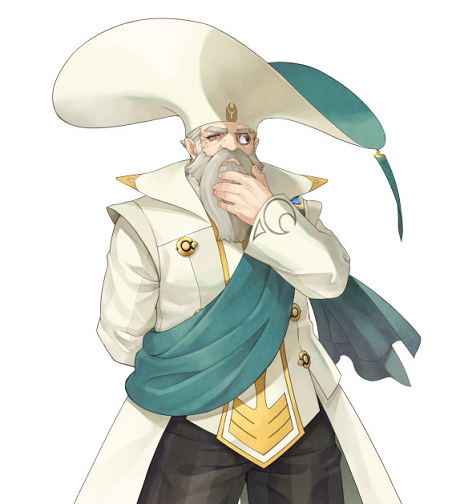
Melchior, an old man with a long beard and a wide-brimmed hat. He is stroking his beard. He wears a white robe and a monocle..


One of Artorius's primary allies is a very, very old man named Melchior (the wiki says he is 130 years old). He is an expert magic user and one of the final obstacles in the protagonists' quest to defeat Artorius. He very clearly fits the visual stereotype that most people will recognize as Merlin, or as any generic wizard (Merlin, Gandalf, Dumbledore -- who can tell them apart when they're all old men with long white beards?). Some older gamers like me may even notice his monocle, which proves that he is a wizard (this is a joke from an old video). Melchior's age also lends to the idea that he is a recreation of Merlin, as Merlin is said to age backwards, or to be immortal, depending on which story you read. In either case, his age is mysteriously connected to his magic. The most notable aspect of Merlin's story that comes into play in Tales of Berseria, however, is the way he is finally defeated in the legends, which brings us to...


Magilou Mayvin AKA Nimuë


Magilou is a blond woman with a pink witch outfit, including a big pointy hat. She has a mischievous look on her face.

Magilou is Velvet's most mysterious companion: especially early in the story, no one knows her age, her real name, what motivates her, or even why she is present in the party. All they know is that Magilou is a self-styled witch who wants to leave her past behind her. Similarly, Nimuë (or Nymue, Nyneue, Nyneve, Nynyue, among countless other variations) has always been a very mysterious figure to medieval storytellers, historians, and modern scholars alike. The important connection between Nimuë and Tales of Berseria's witch Magilou is that Nimuë is often portrayed as being Merlin's apprentice, who ultimately defeats him by trapping him inside a magical cave. By the end of Tales of Berseria, players learn that Magilou was once daughter and student/apprentice of Melchior, and she is pivotal to his defeat. Nimuë is also often said to be the identity of the Lady of the Lake, who is most well known as the guardian of King Arthur's sword, Excalibur. The Lady of the Lake is often portrayed as being a number of different magical women, not only Nimuë, and this tradition is carried on in the "Tales of" games. 


Lailah, The Lady of the Lake


Lailah is a major character in Tales of Zestiria, which takes place several centuries after the events of Tales of Berseria. When players first encounter her, she is the guardian of the Sword in the Stone, a device that is taken directly from Arthurian legends. Though the townspeople can't see her, they worship her as the Lady of the Lake, an apparent title that has been passed on to Lailah from a mysterious predecessor. Lailah is there when Sorey, the protagonist of Tales of Zestiria, attends a festival in which people attempt to pull the sword from the stone, usually with no success. This may sound familiar, as you have probably either seen the Disney movie The Sword in the Stone (based on the T.H. White classic) or heard the legend. Like young Arthur, Sorey is able to pull the sword from the stone, in this case with the help of Lailah (whom he can see while others can't). 


Tales of Zestiria is full of other, smaller references to the Arthurian legends. Many place names come from Arthurian names, such as the Galahad Ruins, Bors Ruins, and other dungeons named after knights, and city names like Taliesin, which is actually named after an early medieval bard whose work was recorded in a famous manuscript. The castle Roundtabel Palace is of course a reference to King Arthur's round table, though I noticed that the table we see inside the palace is actually rectangular -- perhaps as a nod towards the greed of the men sitting around it (Arthur's round table was supposed to be a circle so that no one could sit at the head of the table -- everyone at the table was equal). 


Did you notice any references to Arthurian literature that I missed? Please share your observations in the comments!


Suggestions for Further Reading:


"The Horse and the Heroic Quest: Equestrian Indicators of Morality in Lancelot, Don Quixote, and Tolkien" by Kirsten Rodning


Le Morte d'Arthur by Thomas Malory


The Once and Future King by T.H. White


The Crystal Cave by Mary Stewart


1