
Video Games as Literature: Essays by Kirsten Rodning: Featured

Showing posts with label Featured. Show all posts

Tales of Arthuria: Arthurian Legend Gets the JRPG Treatment in Tales of Berseria

      If you follow Video Games as Literature on Twitter, you may have seen my recent tweet about how, once again, it took me several eons to realize that a literary retelling was staring me right in the face. The tweet states, 


Oh sure, I wrote my master's thesis on Arthurian legends, but it still took me a year to connect the dots and realize the villain in Tales of Berseria was supposed to be a version of King Arthur. 😂😭 (@videogamesaslit Jan 24, 2023 https://twitter.com/videogamesaslit/status/1617762174138716160)


      I'm not afraid to admit that sometimes when I'm gaming I turn off the critical part of my brain and just focus on having a relaxing gaming session. I'm sure we all do that from time to time. It finally hit me when I started playing Tales of Zestiria that this duology (Berseria is a prequal to Zestiria) is filled to the brim with Arthurian references, if not direct retellings of the Arthurian stories. Had I started the games in their release order I may have picked up on this sooner, since Zestiria seems to be a bit more transparent in its Arthurian inspiration. Nevertheless, as I did write several papers and my Master's Thesis on Arthurian legends, I probably should have picked up on this a long time ago. Since I haven't yet finished playing Tales of Zestiria, the details I share in this post will be limited to what I've encountered in the games so far (I have finished Tales of Berseria, at least). Beware spoilers, especially spoilers about characters and character development in Tales of Berseria. This post will be similar to my previous one about Final Fantasy XV and Hamlet, and I will focus mainly on characters who are equivalent to figures in Arthurian legend. Spoilers start now.


Arthur/Artorius Collbrande, AKA King Arthur


Artorius Collbrande, a man with a long blonde ponytail, raises a sword and has a serious expression on his face. There is light shining down on him from somewhere above.

This character is an obvious and typical depiction of King Arthur, and yet I was stumped for the entire year that I played Tales of Berseria because, unlike the illustrious King of the classic literature, he is the villain of this story. Tales of Berseria deftly turns the story of King Arthur upside down and shows the death of Arthur as a necessary act to save humanity.


Velvet Crowe

Tales of Berseria Velvet Crowe, a fair-skinned woman with very long black hair and torn, skintight clothes.

The game's protagonist, though maybe not a hero, Velvet seems to be an amalgamation of two or three Arthurian characters. The most obvious is Mordred, King Arthur's ill-begotten son who was conceived that one time Arthur accidentally slept with his sister (isn't classic literature fun?). Mordred is most often depicted as the instrument of Arthur's undoing, as many of the legends have him giving Arthur his mortal blow. Velvet's violent tendencies and hunger for revenge tie her to Mordred in the legends. But in Tales of Berseria, she is Arthur's sister-in-law (usually referred to in the game as his sister). She does also resemble two of King Arthur's sisters: Morgause (Mordred's mother), and Morgan le Fay, King Arthur's most magical sister. 


The Knights of the Round Table


In Tales of Berseria, Artorius surrounds himself with close companions called exorcists. These characters can be equated to King Arthur's Knights of the Round Table. Some of these characters have obvious ties to Arthurian figures, while others are a little less clear. Shigure Rangetsu, for instance, takes on some of Lancelot's qualities, but is not a true recreation of the character. His most Lancelot-like characteristic is that "His sole joy is to fight tough opponents and seems to enjoy it when his opponent is stronger. He will never turn down a new challenge whenever it arises" (Source: Tales of Wiki). Other exorcists will be covered in more detail below as their characters are more clearly tied to specific Arthurian characters. If you want to learn more about King Arthur's knights, I can verify that Monty Python and the Holy Grail is a surprisingly accurate account of these characters in that it focuses on their most ridiculous qualities as written in the original medieval texts.


Eleanor Hume 

Eleanor Hume, a woman with pale skin and red hair, fighting with a spear. She wears a blue, silver, and gold outfit.

Eleanor Hume may be the most fascinating character in the game, not only because she has an unusual connection to Arthurian Literature, but because her character is actually based on a real-life philosopher: David Hume (b. 1711 d. 1776), founder of Humeanism. In Tales of Berseria, Eleanor begins the story as one of Artorius's exorcists. Artorius teaches his followers that the most important thing in the world is "reason" which he posits is the opposite of emotion. In fact, late in the story Artorius uses his magic to remove emotion from all (or almost all) of the people in the towns nearest to him, and this causes a large number of problems that the protagonists must set out to solve. Eleanor's character development arc in the game sees her changing gradually from a undiscerning follower of Artorius's teachings on reason, to an individual who thinks for herself and sees the importance of human emotion. Her eventual justification for opposing Artorius is that people need their emotions and she won't let him take them away. This thinking follows the writings of her namesake, philosopher David Hume, whose beliefs are described as follows:


An opponent of philosophical rationalists, Hume held that passions rather than reason govern human behaviour, famously proclaiming that "Reason is, and ought only to be the slave of the passions" (Hume, David (1739). A Treatise of Human Nature. London: John Noon). (Source: Wikipedia)


Both Eleanor and David Hume believe that emotions, or passions, are essential to reason, and you cannot have true reason without emotion. 


Eleanor is also connected to Arthurian Literature, albeit in a somewhat tenuous way. Eleanor's given name was very popular in the middle ages: "The popularity of the name Eleanor in England during the Middle Ages was due to the fame of Eleanor of Aquitaine" (Source: Behind the Name). By the time Thomas Malory wrote his book Le Morte d'Arthur, which served as the primary inspiration for most modern retellings of the Arthurian tales, the name Eleanor had been a popular one for several centuries. Instead of using the name Eleanor in his book, however, Malory latched onto a new name that was very similar to Eleanor: Elaine. Malory uses this name for several different characters is his book, to the point that "Elaine" is almost as confusingly common in Arthurian legends as the name "Mary" is in the new testament of the Christian bible. According to Behind the Name, 


[Elaine] appears in Arthurian legend; in Thomas Malory's 15th-century compilation Le Morte d'Arthur Elaine was the daughter of Pelles, the lover of Lancelot, and the mother of Galahad. It was not commonly used as an English given name until after the publication of Alfred Tennyson's Arthurian epic Idylls of the King (1859). (Source: Behind the Name)


Melchior Mayvin AKA Merlin
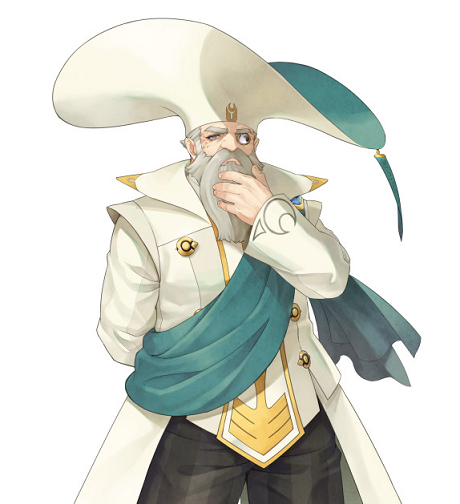

Melchior, an old man with a long beard and a wide-brimmed hat. He is stroking his beard. He wears a white robe and a monocle..


One of Artorius's primary allies is a very, very old man named Melchior (the wiki says he is 130 years old). He is an expert magic user and one of the final obstacles in the protagonists' quest to defeat Artorius. He very clearly fits the visual stereotype that most people will recognize as Merlin, or as any generic wizard (Merlin, Gandalf, Dumbledore -- who can tell them apart when they're all old men with long white beards?). Some older gamers like me may even notice his monocle, which proves that he is a wizard (this is a joke from an old video). Melchior's age also lends to the idea that he is a recreation of Merlin, as Merlin is said to age backwards, or to be immortal, depending on which story you read. In either case, his age is mysteriously connected to his magic. The most notable aspect of Merlin's story that comes into play in Tales of Berseria, however, is the way he is finally defeated in the legends, which brings us to...


Magilou Mayvin AKA Nimuë


Magilou is a blond woman with a pink witch outfit, including a big pointy hat. She has a mischievous look on her face.

Magilou is Velvet's most mysterious companion: especially early in the story, no one knows her age, her real name, what motivates her, or even why she is present in the party. All they know is that Magilou is a self-styled witch who wants to leave her past behind her. Similarly, Nimuë (or Nymue, Nyneue, Nyneve, Nynyue, among countless other variations) has always been a very mysterious figure to medieval storytellers, historians, and modern scholars alike. The important connection between Nimuë and Tales of Berseria's witch Magilou is that Nimuë is often portrayed as being Merlin's apprentice, who ultimately defeats him by trapping him inside a magical cave. By the end of Tales of Berseria, players learn that Magilou was once daughter and student/apprentice of Melchior, and she is pivotal to his defeat. Nimuë is also often said to be the identity of the Lady of the Lake, who is most well known as the guardian of King Arthur's sword, Excalibur. The Lady of the Lake is often portrayed as being a number of different magical women, not only Nimuë, and this tradition is carried on in the "Tales of" games. 


Lailah, The Lady of the Lake


Lailah is a major character in Tales of Zestiria, which takes place several centuries after the events of Tales of Berseria. When players first encounter her, she is the guardian of the Sword in the Stone, a device that is taken directly from Arthurian legends. Though the townspeople can't see her, they worship her as the Lady of the Lake, an apparent title that has been passed on to Lailah from a mysterious predecessor. Lailah is there when Sorey, the protagonist of Tales of Zestiria, attends a festival in which people attempt to pull the sword from the stone, usually with no success. This may sound familiar, as you have probably either seen the Disney movie The Sword in the Stone (based on the T.H. White classic) or heard the legend. Like young Arthur, Sorey is able to pull the sword from the stone, in this case with the help of Lailah (whom he can see while others can't). 


Tales of Zestiria is full of other, smaller references to the Arthurian legends. Many place names come from Arthurian names, such as the Galahad Ruins, Bors Ruins, and other dungeons named after knights, and city names like Taliesin, which is actually named after an early medieval bard whose work was recorded in a famous manuscript. The castle Roundtabel Palace is of course a reference to King Arthur's round table, though I noticed that the table we see inside the palace is actually rectangular -- perhaps as a nod towards the greed of the men sitting around it (Arthur's round table was supposed to be a circle so that no one could sit at the head of the table -- everyone at the table was equal). 


Did you notice any references to Arthurian literature that I missed? Please share your observations in the comments!


Suggestions for Further Reading:


"The Horse and the Heroic Quest: Equestrian Indicators of Morality in Lancelot, Don Quixote, and Tolkien" by Kirsten Rodning


Le Morte d'Arthur by Thomas Malory


The Once and Future King by T.H. White


The Crystal Cave by Mary Stewart


1

Don Quixote and Gaming Disorder

 "Gaming disorder" is a relatively recent diagnostic invention by psychologists who believe that too much gaming is evidence of a mental illness. According to the World Health Organization, 


Gaming disorder is defined in the 11th Revision of the International Classification of Diseases (ICD-11) as a pattern of gaming behavior (“digital-gaming” or “video-gaming”) characterized by impaired control over gaming, increasing priority given to gaming over other activities to the extent that gaming takes precedence over other interests and daily activities, and continuation or escalation of gaming despite the occurrence of negative consequences. (Source)


As an introvert who naturally abhors social interactions, I was immediately skeptical of this newly invented diagnosis, and as an academic who spends a lot of time researching societal impressions of disability, I feared that this diagnosis would be yet another method doctors could potentially use to discriminate against their marginalized patients (which is surprisingly common). I also immediately thought of Don Quixote, a beloved character from the early 17th century who, like many modern gamers, faced discrimination and scorn from his peers simply for enjoying less popular forms of literature.


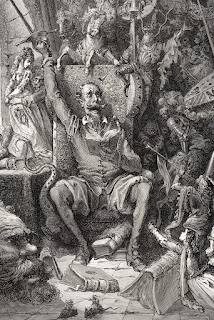
Original Don Quixote Illustration by Gustave Dore

The History and Adventures of the Renowned Don Quixote was first published by Miguel de Cervantes in 1605. If you're like me and can't easily do mental math with big numbers, this was 417 years ago, the same year that William Shakespeare wrote King Lear, Macbeth, and Antony and Cleopatra (source). Yet, even though over four hundred years have passed, Don Quixote's story is remarkably similar to current events and social beliefs, including the idea that video games are a far lesser, cruder media than "high" literature and film. There is no diagnosis that labels readers of books or watchers of film and television as mentally ill, but if you prefer to spend your time playing video games you may be at risk of receiving a mental illness diagnosis (please keep in mind that I do not believe that there is anything wrong with being mentally ill. I do believe that false diagnoses can divert resources from people who really need them, and will muddy the waters when activists are trying so hard to destigmatize mental illness). (This article copyright 2022 Kirsten Rodning.)


In Don Quixote's case, video games wouldn't be invented for a few hundred years, but he was labeled mentally ill by his peers simply for reading the wrong genre of books. Even Cervantes, the author who invented Don Quixote, seems to look down on his protagonist for this reason, writing, 


Be it known, therefore, that this said honest gentleman at his leisure hours, which engrossed the greatest part of the year, addicted himself to the reading of books of chivalry, which he perused with such rapture and application, that he not only forgot the pleasures of the chace, but also utterly neglected the management of his estate." (Cervantes 44)


Very early in this large saga, Don Quixote's "friends" decide they are fed up with his literary preferences, and march to his house to burn his books while he is asleep:


[H]is friends came, and demanded of his niece the key of the closet in which those books, the authors of his misfortune, were kept, and she delivering it with great cheerfulness, they went into it in a body, house-keeper and all, and found upwards of an hundred volumes, great and small, extremely well bound [. . .] "There is not one of them, replied the niece, which deserves the least mercy, for they are all full of mischief and deceit. You had better, therefore, throw them out of the window into the court-yard, and there set fire to them." (Cervantes 75)


Don Quixote shows us that society always has, and always will view some forms of media as being more worthy than others. Nowadays the books that Don Quixote loved so much and was hated for are actually considered to be stuffy old classics. So if your friends and relatives look down at you for playing video games, feel free to tell them that you are a modern day Don Quixote, and that one day those games may very well be considered stuffy classics, too.


For more reading on Don Quixote, check out my thesis The Horse and the Heroic Quest linked here.


Works Cited:

“Addictive Behaviours: Gaming Disorder.” World Health Organization, World Health Organization, 22 Oct. 2020, https://www.who.int/news-room/questions-and-answers/item/addictive-behaviours-gaming-disorder. 


Cervantes Saavedra, Miguel. The History and Adventures of the Renowned Don Quixote. Translated by T. Smollett, Modern Library, 2001. 


0

Final Fantasy: Hamlet

Recently, I finally got around to playing Final Fantasy XV. After about 100 hours of play (not having yet beat the game) it has dawned on me that Final Fantasy XV is a direct retelling of Shakespeare's Hamlet. Okay, so I've been making jokes about similarities between FFXV and Hamlet (and, more specifically, The Lion King) the whole time I've been playing, but I was slow to realize that this was intentional on the part of the game's writers. I've got to say, I'm a little upset that no one pointed this out to me in the four and a half years that I put off playing this game. Anyway, once I actually finish the game I will write my full thoughts on it and its correlation to Hamlet. But without further ado, here is a fun little cast listing for Final Fantasy: Hamlet.

Final Fantasy: Hamlet


NAMES OF THE ACTORS

HAMLET, son to the late King

Screenshot of Noctis from Final Fantasy XV sitting on a rock, posing for the camera.

HORATIO, ROSENCRANTZ, and GUILDENSTERN, friends to Hamlet

Screenshot of Promoto, Gladiolus, and Ignis posing for the camera, with Noctis hidden behind them.

OPHELIA, betrothed to Hamlet

Screenshot of Lunafreya from Final Fantasy XV, appearing to sink into water

LAERTES, brother to Ophelia

Screenshot of Ravus Nox Fleuret from Final Fantasy XV

SCAR CLAUDIUS, King of Denmark

Screenshot of Ardyn from Final Fantasy XV.

Ghost of Hamlet's Father

Screenshot from Final Fantasy: Kingsglaive of King Regis
Source: https://www.gamesradar.com/kingsglaive-final-fantasy-xv-review/

Understudy for the part of HAMLET

Concept art of Richard from Tales of Graces.
Source: https://aselia.fandom.com/wiki/Richard

(I had to include Richard from Tales of Graces in this because he bears more than a passing resemblance to the Prince of Denmark, and also Howl from Howl's Moving Castle. I've always intended to write a little something about him but never got around to doing so.)

Sources: 


0

Disabled Heroes and Heroines in Mass Effect


     One of the most popular and thought-provoking franchises in the Sci-Fi genre continues to be the Mass Effect trilogy (which will be receiving a completely original sequel sometime next year). There are numerous articles and videos on the internet about the ambiguous ending of the original trilogy's story, and any fan of the series you come across is likely to have a lot to say about the ending. I, personally, am usually a fan of bleak endings (unless it involves the death of beloved Harry Potter characters) and found the ending of the Mass Effect trilogy acceptable, if confusing. The developers re-made the game's three endings after receiving a huge amount of backlash from the fan community, and these re-made endings are acceptable to me, if unacceptable to most fans. Why do I find the ending acceptable? Because ultimately, no matter how much "control" the player has over the direction that the story takes, this is still a piece of literature that has been written by an author (in this case, the writers who created this story), and it is the brainchild of said author to be consumed and constructively criticized by players just as a book has a definite ending that one can like or dislike.

    But believe it or not, I'm not here today to talk about the ending of the Mass Effect trilogy. Many, many other people have already hashed out the good and the bad (and the very bad) of Mass Effect 3's final moments. Instead, I'd like to take a look at some of the characters in the series: specifically, Joker, Tali, and Wrex. What do these particular characters have in common? They each have complicated illnesses or disabilities that are intricately dissected and discussed throughout the trilogy. It is extremely rare for a video game to feature major characters with disabilities, and as a person who is disabled, I was surprisingly happy to find characters I could strongly relate to in a AAA video game franchise. Now, the argument has been made to me that Tali and Wrex do not qualify as disabled characters because their entire races suffer from specific diseases. I would argue, however, that in the universal world of Mass Effect, where many races from many planets intermingle in one society, the diseases that affect these particular heroes are setbacks that they must overcome, that other characters are unable to relate to.

     Tali's race, the Quarians, suffer from a fatally low immune system, and even a small scratch in her armor could cause a deadly infection to occur. Even though all members of the Quarian race have this immune deficiency, Tali is uniquely inconvenienced among the heroes of the Normandy crew in that she could suffer from a deadly infection at any time. The only thing that protects Tali from instant death is a specially sealed, technologically advanced suit of armor that her race invented to protect themselves from disease. This suit is as much a hindrance as a help, however. It is very difficult for Quarians to engage in sexual intercourse, and any form of physical contact is almost entirely out of the question. Their faces are concealed, as well, so they have more difficulty communicating with others than members of other species would. Check out the below video for some of Tali's own words on the subject:


   Wrex, another of the primary companions in the series, is a member of the strongest race in the known universe: the Krogans. Krogans are often recruited as mercenaries and used as soldiers in war because of their strength and battle-oriented disposition. Why, then, would Wrex, or any Krogan, be considered disabled? Because in the history of the Mass Effect universe, the Krogans were infected with a disease known as the "genophage" which prevents the Krogan from reproducing. All Krogan are infected with this disease. According to the Mass Effect wiki,
The genophage's modus operandi is not to reduce the fertility of krogan females, but rather the probability of viable pregnancies: many krogan die in stillbirth, with most fetuses never even reaching this stage of development. Moreover, every cell in each krogan is infected, to prevent the use of gene therapy to counteract it. (Source)
 While the genophage does not inhibit Wrex's ability to aide Shepard or perform his duties to his fellow Krogans, it is a disease that he is constantly battling with and aware of at every step of the story. Every decision that Wrex makes is affected by his disease, and ultimately the aide of the Krogans in the final battle of the story hinges on whether or not Shepard is able to arrange for a cure to be created and given to the Krogans. If the game did not constantly remind us at every turn that the Krogans are sick I might not have included Wrex in this article. But the genophage is a huge part of Wrex's personal identity, and it cannot be ignored.

     Finally, the most obviously disabled character in the Mass Effect series is Joker, the well-liked pilot of the Normandy voiced by Seth Green. Also known by his given name, Jeff Moreau, Joker is usually seen sitting in the cockpit of the Normandy. The Mass Effect wiki describes Joker's condition:
Joker's upbringing and career have been colored by his health. Joker has a moderate to severe case of Vrolik syndrome, which causes extreme brittleness in the bones; he was born with severe fractures to his legs and even with modern medicine he finds walking nearly impossible, relying on crutches and leg braces. (Source)
Joker's condition is usually only discussed in passing, and is often easy to forget as we normally never see him leave his seat. Joker tells us that he was able to become a pilot because, despite his condition, he was the top student in flight school and even surpassed many of his instructors in skill. In Mass Effect 2, Joker's illness is brought to the forefront of our minds, however, when Commander Shepard and the rest of the heroes of the Normandy conveniently leave the ship on a shuttle to perform a mission of some sort, and Joker is alone when the Normandy is attacked. The player suddenly finds herself playing as Joker, and must limp slowly through the ship to activate the ship's defense systems. The following video shows this scene (warning: there are a LOT of spoilers for Mass Effect 2 in the following video, so don't watch it if you're not ready!):


Though you may not be able to tell from watching the video, limping along as Joker at an agonizingly slow pace while aliens are attacking the ship is a terrifying experience. I think the scene does a great job of giving players a bit of understanding of how scary it can be to be disabled, especially in the midst of a crisis. I also applaud Bioware for creating one of the very first player-characters that is disabled, even if you only play as this character for about five minutes. As I mentioned in the beginning of this article, disabled characters are very rare in video games, and playable characters with disabilities are almost non-existent. Occasionally you'll play a game where your protagonist has an eye patch (and is presumably missing an eye), but rarely does that actually hinder the character's abilities as it should (the main exception can be found in Metal Gear Solid 3, which I won't spoil here). 

     I find it remarkable that Bioware was able to delve so deeply into the topic of disability with their characters in the Mass Effect series, but then, Bioware is known for being very progressive for a game company. Tali is my favorite character in the Mass Effect universe primarily because I have never before been able to relate to a game character in terms of my disability. I am eager to see how disability, gender roles, and all sorts of other important topics are brought to light in the newest addition to the franchise, set to release next year. 
2

Exploring New Forms of Narrative with Bastion


   Bastion: one of my favorite games of all time. I first played the game a few years ago when it was sold in one of the early Humble Indie Bundles. Now that the game is also available for PS4 and PS Vita I've decided that it's finally time to write about it.

     I immediately fell in love when I heard the narrator and realized that he was narrating everything that happens, because it's all part of the story. The narrator begins the story with "Proper story's supposed to start at the beginning. Ain't so simple with this one." The narrator then goes on to describe everything that happens; everything that the player causes the character she is controlling to do. The narrative can fluctuate based on the choices that the player makes. If you lead the PC, called simply "The Kid," to stay in one area and destroy all of the objects in sight, the narrator will say, "The kid just rages for a while." In a sense one could say that this narrator is telling the story in a stream-of-consciousness style. That style is highly unusual for a third-person narrator as he is narrating something that another person is doing, as opposed to narrating his own actions. Dictionary.com has several good definitions of "stream-of-consciousness"; here's a good one: "Of, relating to, or characterized by a manner of writing in which a character's thoughts or perceptions are presented as occurring in random form, without regard for logical sequences, syntactic structure, distinctions between various levels of reality, or the like." As the narrator himself says at the beginning of the game, he is not telling this story in a chronological or linear order. Instead, players experience the story from a point after the vague "calamity" that has occurred. Through finding objects and dusty remains of townsfolk we learn a bit about the world in which The Kid lived before said calamity. Certain things are never fully explained; for instance, players can never truly grasp what exactly the calamity was (Just that an act of war went horribly awry, as they tend to do) or why the paltry remains of the town are elevated in the sky. Even so, the story that is given is beautiful and heart-wrenching. Likely the vagueness of certain elements of the story are as ambiguous as they are because the player is gleaning information that only the narrator and The Kid know. These characters were not directly involved in the events that caused the calamity and through their own confusion and post-traumatic stress players must put together the pieces of the story.

     In some ways the delivery of this heart-wrenching story depends on the beautiful music and painted scenery in the game. Most of the few characters found in the game have their own vocalized theme song. Even if you don't listen to the lyrics (which are often surprisingly aggressive) the songs can bring a tear to your eye. The beauty of the world that has been destroyed by the calamity is still evident when The Kid visits various locations, and sadness can be found in the narrator's description of how the world once was, and the fact that this new world through which The Kid trudges is, though beautiful, no match for the pre-calamity world.

At the end of the game, the player is presented with a hard choice. The player's own moral perspective is invoked here, as there is no clearly right choice. Arguments are made for each possible outcome, and the player's choice affects the future of the world in which she has just likely spent approximately 10 or so hours. I won't say any more on the topic for fear of spoiling the game, but I will say that after you, the player, make this choice, you will likely wish to re-start the game in New Game Plus just so you can re-enter the world of Bastion and see what happens when you make the other possible decision.

For any of you who have already played Bastion, which version did you play? If you've played multiple versions, which did you prefer? I will admit that I preferred the PC version over the PS Vita version (which is what I have most recently played). The graphics seemed to have been scaled down a tad for the Vita version (I haven't played the game on PS4 yet, so I don't know if this statement applies there, as well), though it has been a few years since I first played Bastion on the PC. 
2

What exactly is "Beyond" Good and Evil?


     I recently finished cult classic Beyond Good and Evil for PS3 (the HD re-release) and found myself asking what the title means. Of course, there are a multitude of books and papers that discuss the difference between Good and Evil, how the concepts started, and the grey area beyond. My musings here will only cover the meaning within the game, as I don't have time to analyze the most controversial concept in human, nay, universal, history. For that, you can read Nietzsche. But I must wonder, why did the creators of this game decide to give it such a lofty title? Is the game deserving of such a heavy burden? Does it actually have anything to do with the pre-existing book of the same name?

     First, let me break the game's storyline down into its most basic plot points and symbols:
  • Family and Friendship
  • Human trafficking 
  • Finances
  • Aliens
  • Photography
Photography aside, these are pretty heavy concepts, to be sure. There isn't much that can bring a jolly conversation to a screeching halt quite like the topic of human trafficking. Aliens are no laughing matter, either. And yet Beyond Good and Evil somehow manages to bring all of these concepts together without receiving an AO rating.
     The game's protagonist, Jade, becomes involved with an underground organization whose purpose is to expose evil deeds being committed by a militarized government. Jade's task is seemingly simple: using her trusty camera, Jade must capture photographic evidence of the government's misdeeds. Jade soon discovers, to the player's likely horror, that the government is literally kidnapping people and shipping them off to the moon to take part in a The Matrix-like alien slave trade. Throughout the story players follow Jade's interactions with her motley crew of different-species family members and friends, and constantly hear little bits of proverb about not leaving team-mates behind (particularly when a NPC party member gets stuck behind a door or otherwise falls behind). In some ways, the lessons taught here are simplistic and Sesame Street-like, though I must defend Sesame Street; at least, in my youth, it was a pretty complex show that taught valuable lessons to children and their parents while taking kids seriously. Maybe, like Sesame Street, Beyond Good and Evil intends to reach an open and impressionable audience and spread the message that family and friends are important treasures to cherish and protect. Cue the Yip Yips.


So, maybe familial and platonic relationships are beyond good and evil: maybe one must put aside all of one's personal affects when the life of a family member is at stake. Jade fights for good by exposing the evil being perpetrated by the corrupt government, but she is more personally motivated to action when her uncle is kidnapped. In this way, Jade sees her family as being more important than, or beyond, the philosophical fight between good and evil.

     Have you played Beyond Good and Evil? What do you think is beyond the concept of good vs. evil? How might the game developers have concocted such a title? Of course, the most pressing question for most gamers is: will there be a sequel?

     Don't forget: this month is Sci-Fi Month! What are your favorite literary sci-fi games?
0

Far Cry 3: An Intensely Immersive Experience


     Once again I am far behind when it comes to my extremely large backlog of games. Recently I finished playing Far Cry 3. Having never played the previous games, I knew little about what to expect -- I had mostly only heard that the game is very violent and that the open-world experience is incredible. When I was told (by multiple sources) that the story was also enjoyable, however, I knew this was a game I couldn't pass up. So I got a copy of the game for PS3 and started playing -- and couldn't stop. The story in this game was so well done I found myself reacting to the story as I would a mystery novel. Immediately upon completing the "tutorial" portion of the game, a character is killed. Before this point, I had already been thinking to myself, "He's a cool character -- too bad he'll be the first to be killed off." Note that I had no prior experience with this game or series -- the storyline is just good enough in its narrative that I was able to analyze the story as I played, much as I would analyze the story in a novel as I read.
     The creators of the game knew exactly what they were doing with the narrative when they created it. Like the great mystery authors of old, the creators of Far Cry 3 were able to predict exactly how their audience would react to situations and characters within the game, and they used a variety of techniques to let the player know that their thoughts were already known. As I said, the game is very violent. The violence does not detract from the story, however -- in fact, it adds to the experience and, if you are paying enough attention, it causes a lot of self-reflection. Much of the story revolves around villainous groups of modern-day pirates and those who do business with them. Many players will find that, though they can see that these villains are doing truly evil things, they actually like these characters. This is because the game's writers have made the pirates likeable, regardless of their evil deeds. After the battle with the first "boss" of the game, the game's writers make it clear that they know about your affection for the character that has just been killed by briefly showing a simple quote from Through the Looking-Glass (otherwise known as the second book in the "Alice in Wonderland" duo): "'I like the Walrus best,' said Alice: 'because he was a little sorry for the poor oysters.' 'He ate more than the Carpenter, though,' said Tweedledee" (Carroll 236).
     By viewing this simple literary quote, players know that the character they just battled -- a character they found themselves liking -- is a representation of the Walrus, while the player is Alice. The same introspection that Alice must go through when she learns that the Walrus only seemed sorry for the oysters he consumed is then felt by the player, who must then think about the terrible things that this seemingly fun and favorable character has done. Alice's Adventures in Wonderland quotes are actually used throughout the game. This is a common occurrence -- many modern media that revolve around a character lost in a strange and unusual land use references to Alice. What is important here is the way in which the quotes are used. They truly make the player take pause and think for a moment about what is happening in the game.
     Being an open-world game, there are a lot of opportunities for players to customize their experience with the game. In this game, however, the entire experience is created to elicit specific emotions from the player. At one moment, a player might be driving along in a car stolen from the pirates, listening to the radio that plays in most vehicles on the island. The player may suddenly see a person sitting in the middle of the road and have to stop or swerve to miss that person. When the player exits the car, she may find that the person in the road is a woman leaning over the corpse of a man and crying. One might infer that the man was killed by the pirates, or hit by another reckless driver on the road. Perhaps it was even the player who hit the man -- and now the player must see the results of her actions. Small moments like this are littered throughout the game. Even playing Poker can seem like a real experience. Though the NPCs that you are playing Poker with may repeat themselves from time to time, as NPCs tend to do, the atmosphere can make the experience seem more real than any other video poker game you have previously played. At one point I was playing poker with three other guys in a small bar on the beach. It was relatively dark in the bar, and it was night-time in the game. Suddenly, it began to storm in-game; the thunder was quite loud and realistic and the lightning could be seen through the windows. I felt a sense that I was actually playing cards with neighbors during a power outage.
     It's difficult to describe the incredible experience that this game provides without giving away too many spoilers, so I would recommend playing the game yourself so you can see exactly what kind of experience the game creates for you. And now it's time for me to get Far Cry 4.


Announcement: Video Games as Literature will be participating in Sci-Fi month November once again this year! You can read about the event here. Last year I had a number of great ideas to write about for the event, but this year my brain's a bit dry in the idea department. If you have any suggestions for sci-fi related games that I should write about, please leave a comment!

Works Consulted:

Carroll, Lewis. The Annotated Alice: Alice's Adventures in Wonderland & Through the Looking
     Glass
. New York: Clarkson N. Potter, Inc., 1960. Print.
3

Final Fantasy IX and the Shakespearean Tradition

Spoiler Warning: this post contains spoilers for the game Final Fantasy IX and possibly for various Shakespeare plays. 


Image Credit: Final Fantasy Wiki

         It may seem to some a bit of a stretch to connect a Final Fantasy game with Shakespeare, but some may also realize that much of today's popular fiction, in any medium, is influenced by Shakespeare to some degree. Final Fantasy IX, of all the Final Fantasy games, seemed to be most highly influenced by the bard and is filled with elements from his plays. The game even has constant allusions to a fictional playwright named Lord Avon (a reference to Shakespeare's birthplace) and his play entitled "I Want to Be Your Canary." The protagonist of the story, Zidane, is a member of a troupe of actors who also take on nefarious tasks on the side. At the beginning of the game, Zidane and his troupe are about to perform "I Want to Be Your Canary" for the queen and princess, as well as any townspeople who manage to obtain a ticket to the show. "I Want to Be Your Canary" bears a striking resemblance to "Romeo and Juliet" as the story revolves around a forbidden love, which ends in the lovers' deaths. During the play, we witness young Vivi trying to access the arena where the play is being performed, only to be turned away. Vivi, however, is befriended by an impish boy named Puck, who helps him sneak in to watch the show. Yes, Puck resembles his namesake from "A Midsummer Night's Dream" and may be an intentional reference.

      Aside from the obvious references presented in these opening scenes, there are many Shakespearean elements that are used throughout the game. A major element present is the motif of separated twins. Late in the game Zidane learns that the antagonist of the game, Kuja, is, in fact, his brother -- and not only his brother, his twin. Shakespeare uses the archetype of separated twins frequently throughout his plays. One of his notable uses can be seen in "The Comedy of Errors", in which the separation of two sets of twins causes a maelstrom of mistaken identity jokes and confusion. Final Fantasy IX does not follow this pattern, however, because Kuja has changed his appearance drastically enough that he and Zidane do not strongly resemble each other. The animosity between the two brothers more closely resembles "The Tempest," in which Prospero seeks revenge against his brother.

      Another common Shakespearean element present in Final Fantasy IX is regicide; yes, it's Shakespeare's favorite plot device, which can be found in Hamlet, Macbeth, King Lear, etc. (Too many of Shakespeare's plays contain regicide for me to list them all). In Final Fantasy IX, Queen Brahne becomes a principal villain, and the characters must battle her actions throughout much of the story. Queen Brahne's death is not caused by a direct homicide, but rather through an act of war directed by Kuja. Yet Brahne represents the crazed monarch that Shakespeare so often wrote into his plays -- she is reminiscent of King Lear, Macbeth, or even Richard III, and she is killed through human actions.

      I could likely write an entire book on Shakespearean influences in Final Fantasy IX, but the above are some of the most prevalent examples. The inclusion of a fictional playwright named Lord Avon and a play that is closely based on one of Shakespeare's most famous plays indicates that the creators of Final Fantasy IX were familiar with Shakespeare and likely intended to write the story for the game in the Shakespearean tradition. 

Works Consulted:

"Final Fantasy IX." Final Fantasy Wiki. n.d. Web. 8 Nov. 2013. 
      <http://finalfantasy.wikia.com/wiki/Final_Fantasy_IX>
"Final Fantasy IX." dir. Hiroyuki Ito. Square, 2000. Video Game.
Shakespeare, William. The Norton Shakespeare. Ed. Stephen Greenblatt. New York: W.W. Norton &
      Co., 2008. Print.
3

"Shadow of the Colossus" as an Example of Post-Modern Literature

Spoiler Warning: If you have not played Shadow of the Colossus and intend to play it, note that there will be spoilers as I will describe the events that take place at the end of the game.

An image of Wander on horseback, firing an arrow at the second colossus.


     I'm sure the title of this post will raise quite a few eyebrows for several reasons. Some literary scholars argue that post-modernism doesn't really exist and that we are still within the scope of the modernist movement today, or that we have entered into a movement that cannot yet be labeled. I am not yet certain where my own beliefs lie in this subject, but I have noticed many similarities between the structure of the cult PlayStation game "Shadow of the Colossus" and the commonly agreed upon definition of post-modernism. This is what I will be analyzing in my post.

     A definition of post-modernism is given in the Norton Anthology: Postmodern American Poetry. The introduction to the anthology states that post-modernism "Suggests an experimental approach to composition, as well as a worldview that sets itself apart from mainstream culture and the narcissism, sentimentality, and self-expressiveness of its life in writing. Postmodernist poetry is the avant-garde poetry of our time" (Postmodern American Poetry xxv). The author then states that he could also have titled this anthology as "experimental" or "avant-garde" poetry, as those terms are similar in concept to "post-modernism". 

     I feel that this definition very neatly describes the story and concepts given to us in the video game "Shadow of the Colossus". The game begins with a simple story. A boy has brought a female companion to a shrine that he had to travel many miles to reach. The girl appears to be dead, or in a very deep coma. In this shrine, he learns from a disembodied voice that if he defeats 16 colossi, he will be rewarded in some way. With the boy, we hope that the reward will be a gift of life and health to the girl so that the boy and girl can live happily ever after. If this were a traditional story (pre-modern, we could say), the task would be simple: the boy would defeat the colossi and he would win the girl. Happy endings and celebrations would ensue. This is not the case with our hero, however. Fighting in an existentialist world, the boy (often known as the wanderer) defeats each of the colossi, which causes each of the individual statues in the shrine that represent the colossi  to break. Each time the boy defeats a colossus, he is filled with a dark cloud that seems to cause him pain, but he fights on to save his female companion. To a casual observer who is not closely following the story, this might seem like a simple tale of chivalry. A closer interpretation of the events that are taking place, however, would set a player into an uneasy state -- it doesn't seem right for the boy to be killing these colossi. Many of them are docile and do not seem to be causing any harm to anyone, and what is going on with that black cloud that continuously attacks our hero? At the end of the story we learn the horrible truth. These colossi were benevolent guardians of the land, and the boy has destroyed them and thus has led evil into the valley. The boy's wish is granted, but at a terrible price -- the girl awakens to find that her hero has now become... a baby? The ending is rather confusing. Our last glimpse of our main characters shows the previously comatose girl caring for our infant hero. 

     As a work of post-modernism, we can understand that the storyline of this game fights traditional expectations of both literature and traditional game plots. The hero does rescue the girl, but the ending is not a happy one. Instead, like many works of post-modern literature, we are left confused. The world in which this story takes place is not an optimistic one. There is constantly a feeling of imminent failure and doubt. Am I, playing as the hero, doing the right thing? Is there any way to reverse the horrible actions I have taken? Now that I realize that killing the colossi is an act of evil, can I redeem myself? The ultimate answer is no: the only course of action that he can take is to continue his path of destruction with the tiny glimmer of hope that he will still be able to revive his companion. This complex concept can easily qualify "Shadow of the Colossus" as a work of literature worthy of analysis. 

     Another idea I would like to note here is that the story seems to heavily reference a scene from the ancient text The Epic of Gilgamesh. Though this subject does not necessarily add to the conversation about post-modernism it is interesting to point out as an argument for "Shadow of the Colossus"'s literary merit. The scene is described in the Norton Critical edition as follows:
The adventurers begin to harvest timber and are encouraged by the Sun-god to attack the guardian of the forest before he can prepare himself. As battle is joined, Huwawa [the guardian] issues a threat to Gilgamesh and Enkidu but is unable to carry it out. . . . When the monster begs for mercy, Enkidu dissuades Gilgamesh from granting it. (Gilgamesh 160)
      In this scene, Gilgamesh is instructed by a deity (similar to the disembodied voice that instructs the wanderer) to destroy the guardian of the forest, Huwawa. Huwawa has done nothing wrong -- he is merely guarding the trees in the forest from harm, much like the colossi guard the land in "Shadow of the Colossus". It takes two men with axes and the help of a god to bring the so-called "monster" down, but in the end Huwawa is defeated. This concept is similar to the one hero in "Shadow of the Colossus" who defeats monsters who are many times larger than he is, with the urging of some sort of spirit or deity.

I will end this with a few relevant comments about my personal "Shadow of the Colossus" experience:
  1. I have not yet played Ico. I know -- boooo!
  2. I have only completed the Playstation 2 version of SotC, and though I have played much of the PS3 remake, I have not finished it.
Thus my interpretation of the game comes solely from the plot that takes place in the PS2 version.

Works Consulted:
Hoover, Paul, ed. Postmodern American Poetry: A Norton Anthology. New York: W.W. Norton & 
      Company, Inc., 1994. Print.
Shadow of the Colossus. Dir. Fumito Ueda. Sony Computer Entertainment, 2005. Video Game.
The Epic of Gilgamesh. Trans. Benjamin R. Foster. New York: W.W. Norton & Company, Inc., 2001.     
      Print.

Edited on 3/13/2020 to include a screenshot from the SotC remake.
8