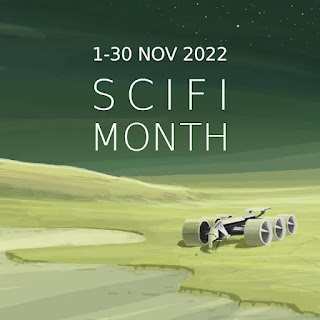
It's Sci-Fi Month! Every November a bunch of blogs, including this one, celebrate #SciFiMonth and read science fiction books, play Sci-Fi games, and generally geek out. This year is the tenth anniversary of the event! It's hosted by OneMore.org and Dear Geek Place.
Artwork by Simon Fetscher
As usual, I plan to have a fairly chill month since I am also participating in Nanowrimo. Last month I boasted on Twitter that I was thinking about doing a Resident Evil marathon, but since that has fizzled out for me I will probably focus my time on different games. I have been wanting to get into the Star Ocean series for a very long time, and I think now, during Sci-Fi month, and so near the release of the latest Star Ocean installment, would be a great time! Now, I know that different people have different opinions on where I should start in the Star Ocean series (I did some research on social media), but since the PS3 game, Star Ocean: The Last Hope, is within easy reach I plan to "dive in" with that one (pun totally intended). If that doesn't fill up all of my gaming time for the month, I will probably also go back to trying to finish Assassin's Creed Odyssey, which I have already started a blog post draft on. I need to stick to my resolution to finish a Tales series game this year, so I will also keep working on beating Tales of Berseria.
As far as reading goes, I'm not sure what all of the books I read this month will be, but I will try to stick to the Science Fiction theme. The first one I'm reading for the month, which I started last night, is Victories Greater Than Death by Charlie Jane Anders! The story is really different so far -- which is always a good thing! I'm only a few chapters in so my full review will be forthcoming. There is an official #SciFiMonth readathon taking place, in which participants will be reading The Galaxy, and the Ground Within by Becky Chambers. I haven't read the rest of the series in which that book takes place, so I might be skipping the readathon this time.
Stay tuned for more #SciFiMonth updates! And happy gaming/reading.
If you enjoy my work and would like to support this blog, feel free to check out the links below.
For my first official act of Sci-Fi Month 2021, I played the new indie game Unsighted by Studio Pixel Punk (check it out on Steam here). While I played the PC version, this game is also available on Switch, X-Box, and PS4. Unsighted is an original game with a science fiction setting where the majority of characters are automatons, including the game's protagonist, Alma. Veteran gamers will notice subtle references to the Legend of Zelda series: in the music, sound effects, collection of items, and especially in the fairy automaton companion who travels with Alma in her journey to save her friends. References to other games and even to gaming culture abound, and my favorite reference is to @CanYouPetTheDog, which is apparent in achievements you receive when you, naturally, pet the dog.
Screenshot of a dog being petted by Alma.
I was not able to finish the game before posting the review, but in the approximately 9 hours in which I played the game I got a very good feel for all of the important elements you may need to know (According to HowLongToBeat.com, it should take most players between 7 and 15 hours to complete the main story of Unsighted, but if you know me you know I am usually the most leisurely of players and I take my time enjoying the story, characters, and environments so I tend to fall on the longer end of the play-time spectrum, meaning that I played maybe about half the game.)
The rest of this review will be divided into categories, in the order of which I think the game did best. My personal feelings about the game lean strongly on the positive side, but there were a few areas where I thought the game could be improved.
1) Characters
If there were a game of the year award for best characters, I would give it to Unsighted. The developers clearly put a lot of work into creating a wide variety of individual characters with their own personalities and attributes. The secondary characters are just as important to the story as Alma herself, since a main goal of the game is to save as many of them as you can. Alma's friends will truly tug at the player's heartstrings as they tell you about their past with Alma, their lives before the war began, and their goals for the future. It is also important to note that even though the characters are automatons, and were canonically manufactured by humans, they still represent a range of body types and racial features, showing players that there is no one "generic" look for humans or for automatons. My personal favorite characters, and the ones I first gave my meteor dust to, are Samuel and Tobias.
2) Story
As you may have been able to tell in the previous section, the story is simultaneously heartwarming and sad, almost like a Pixar movie. This makes the game hook players in, as we want to reach the end to find out what happens to the characters and world we've grown to love. Some parts of the story do seem overly dreary from time to time -- a war is actively taking place and there are horrors roaming the land -- some of which were previously automatons who could even have been friends with Alma. These dreary parts are simply part of the overall picture, however, and if you are able to focus on the good parts (reuniting with Alma's friends and meeting new ones, collecting and crafting tools, etc.) you can easily get through the more scary parts. Think of the Fallout series, but with fewer zombies and more cute puppies.
3) Accessibility
In terms of accessibility, I can't speak for everyone's accessibility needs. I can, however, speak for my own, and this game certainly has better accessibility options than most games. There are some areas where I feel the game could be improved. First, the difficulty settings are great, and even greater: there's an invincibility mode. There are also settings to make a lot of other aspects of the game easier for disabled people, including text size options (I'm glad these exist though I feel the difference in size for the three size options could have been greater), font options, and the ability to switch between keyboard/mouse and controller as needed. The biggest issue I faced as someone with low vision was that the environments were difficult to navigate, and I believe this would have been difficult even if I didn't already have vision problems. I'll talk about this more in the level design and graphics sections of my review. See the screenshots below for the option pages.
This is not exactly an accessibility problem, but I will say it here anyway. The title of the game comes from the tragedy that occurs to automatons whose time runs out: they become "Unsighted." This is where they lose themselves and their personalities and basically just become killing machines. The wording used for this tragedy unnerves me -- is it ableist against blind people to equate loss of sight to loss of self? I don't want to be the definitive voice on this matter as I myself am not completely blind, but it is something to think about.
Edited on 11/30/2021 to add: Fernanda Dias, one of the developers of the game, messaged me on Twitter to clear up my confusion about the word Unsighted. She said, "UNSIGHTED in the game means "missing", not "blind". When an automaton is about to become unsighted, they often flee and hide in order to not hurt others around them."
4) Graphics
Graphics, of course, are a very subjective category. Personally, I have grown especially fond of 16-bit style graphics in recent years, in large part due to my love for Stardew Valley. While some players may not love the art style of Unsighted, which falls into the pixel-graphics category, it is still quite clear that the game's designers put a lot of work into the art of the game, from the individual characters who each have their own unique look, to the architecture of the setting, like the old gothic cathedral that is central to the main city in the game. Even the weather looks spectacular -- there are many instance when it is raining, and yet the characters and backgrounds stand out among the raindrops. The only problem with the graphics is that sometimes it's hard to tell the difference between the floor and the roof of the building next to you. Is that a building, a platform, or a pit where Alma might fall to her death? Sometimes you have to take a leap of faith and just... find out, and with the *very* unforgiving HP bar you have in this game, testing a black section of the game and falling can mean game over. Thankfully, the game has that aforementioned invincibility mode, so if you're in an area (like the city) where there are a lot of deadly pits, you can just turn on invincibility as you navigate your way through the world.
5) Controls
The controls are... fine. They're fine. But they could be better. I am always happy when a game allows for controller or keyboard/mouse input on PC. That said, I feel like there are some things you have to do manually that could have been mapped to the controller/keyboard better. For instance, I couldn't find an easy way to switch between equipment quickly. It got really frustrating in certain parts of the game where I needed to switch between three or so different things on a very regular basis. Alma only has two hands, so of course she is only able to hold two pieces of equipment at once (including her sword, which I used for most of the battle in the game). I would have liked a quick switch feature like the one you find in most Zelda games, or in Animal Crossing New Horizons. Otherwise I had few gripes with the controls. They're generally pretty basic and easy to follow.
6) Level Design & Puzzles
I hear some people really like puzzles in their adventure games. For some people, it's really exciting to push giant boxes around and try to figure out how to get to the next room (even though you have bombs and/or grenades in your inventory and... couldn't you just blow a hole in the wall?). If you didn't figure it out yet, I am not one of those people. This may originate in the fact that I was a "gifted kid" growing up and from an extremely young age I was constantly forced by the school system to complete puzzles and brainteasers, and that got tiring. But I digress. There are a lot of these types of puzzles in Unsighted, which you might expect from a game that is heavily inspired by The Legend of Zelda. And of course, I can handle a puzzle or ten in my games -- I do play a lot of adventure games, after all. But when I have to do several puzzles that are difficult to figure out, I get tired, and I feel like Unsighted lands just over the line of what constitutes "too many puzzles." Unsighted's puzzles may not be so frustrating that I rage-quit the game, but they are often frustrating enough to deserve a mention. You will have to work your brain with this game. Whether that's an exciting prospect or not is up to you. And as I mentioned, there are issues with the perspective in the game's level designs that may have you confused about where Alma can and can't walk -- this in itself is a bit of an unwanted puzzle.
A few notes to conclude my review: as I was playing the game the developers were regularly releasing patches, so if I mentioned an issue that you can't find in the game, it may have been patched before or soon after this review was published! This is one of the wonderful things about playing indie games whose developers really care about the game and its players.
I received a copy of Unsighted for free in exchange for an honest review.
For more information about Sci-Fi Month, click here.
Once again, November is here and with it comes Sci-Fi month! If you're unfamiliar with this yearly event, you can read more about it here. This month I will be focusing on some indie science fiction games. Early in the month I will be reviewing Unsighted, a new release from indie developer Studio Pixel Punk. I hope to also catch up on some sci-fi games from my infinite backlog. Depending on how I'm feeling and on how busy I am I may also try to fit in some book reviews? Nothing too ambitious.
The artwork for this year's promotional material was made by Liu Zishan.
One of the most popular and thought-provoking franchises in the Sci-Fi genre continues to be the Mass Effect trilogy (which will be receiving a completely original sequel sometime next year). There are numerous articles and videos on the internet about the ambiguous ending of the original trilogy's story, and any fan of the series you come across is likely to have a lot to say about the ending. I, personally, am usually a fan of bleak endings (unless it involves the death of beloved Harry Potter characters) and found the ending of the Mass Effect trilogy acceptable, if confusing. The developers re-made the game's three endings after receiving a huge amount of backlash from the fan community, and these re-made endings are acceptable to me, if unacceptable to most fans. Why do I find the ending acceptable? Because ultimately, no matter how much "control" the player has over the direction that the story takes, this is still a piece of literature that has been written by an author (in this case, the writers who created this story), and it is the brainchild of said author to be consumed and constructively criticized by players just as a book has a definite ending that one can like or dislike.
But believe it or not, I'm not here today to talk about the ending of the Mass Effect trilogy. Many, many other people have already hashed out the good and the bad (and the very bad) of Mass Effect 3's final moments. Instead, I'd like to take a look at some of the characters in the series: specifically, Joker, Tali, and Wrex. What do these particular characters have in common? They each have complicated illnesses or disabilities that are intricately dissected and discussed throughout the trilogy. It is extremely rare for a video game to feature major characters with disabilities, and as a person who is disabled, I was surprisingly happy to find characters I could strongly relate to in a AAA video game franchise. Now, the argument has been made to me that Tali and Wrex do not qualify as disabled characters because their entire races suffer from specific diseases. I would argue, however, that in the universal world of Mass Effect, where many races from many planets intermingle in one society, the diseases that affect these particular heroes are setbacks that they must overcome, that other characters are unable to relate to.
Tali's race, the Quarians, suffer from a fatally low immune system, and even a small scratch in her armor could cause a deadly infection to occur. Even though all members of the Quarian race have this immune deficiency, Tali is uniquely inconvenienced among the heroes of the Normandy crew in that she could suffer from a deadly infection at any time. The only thing that protects Tali from instant death is a specially sealed, technologically advanced suit of armor that her race invented to protect themselves from disease. This suit is as much a hindrance as a help, however. It is very difficult for Quarians to engage in sexual intercourse, and any form of physical contact is almost entirely out of the question. Their faces are concealed, as well, so they have more difficulty communicating with others than members of other species would. Check out the below video for some of Tali's own words on the subject:
Wrex, another of the primary companions in the series, is a member of the strongest race in the known universe: the Krogans. Krogans are often recruited as mercenaries and used as soldiers in war because of their strength and battle-oriented disposition. Why, then, would Wrex, or any Krogan, be considered disabled? Because in the history of the Mass Effect universe, the Krogans were infected with a disease known as the "genophage" which prevents the Krogan from reproducing. All Krogan are infected with this disease. According to the Mass Effect wiki,
The genophage's modus operandi is not to reduce the fertility of krogan females, but rather the probability of viable pregnancies: many krogan die in stillbirth, with most fetuses never even reaching this stage of development. Moreover, every cell in each krogan is infected, to prevent the use of gene therapy to counteract it. (Source)
While the genophage does not inhibit Wrex's ability to aide Shepard or perform his duties to his fellow Krogans, it is a disease that he is constantly battling with and aware of at every step of the story. Every decision that Wrex makes is affected by his disease, and ultimately the aide of the Krogans in the final battle of the story hinges on whether or not Shepard is able to arrange for a cure to be created and given to the Krogans. If the game did not constantly remind us at every turn that the Krogans are sick I might not have included Wrex in this article. But the genophage is a huge part of Wrex's personal identity, and it cannot be ignored.
Finally, the most obviously disabled character in the Mass Effect series is Joker, the well-liked pilot of the Normandy voiced by Seth Green. Also known by his given name, Jeff Moreau, Joker is usually seen sitting in the cockpit of the Normandy. The Mass Effect wiki describes Joker's condition:
Joker's upbringing and career have been colored by his health. Joker has a moderate to severe case of Vrolik syndrome, which causes extreme brittleness in the bones; he was born with severe fractures to his legs and even with modern medicine he finds walking nearly impossible, relying on crutches and leg braces. (Source)
Joker's condition is usually only discussed in passing, and is often easy to forget as we normally never see him leave his seat. Joker tells us that he was able to become a pilot because, despite his condition, he was the top student in flight school and even surpassed many of his instructors in skill. In Mass Effect 2, Joker's illness is brought to the forefront of our minds, however, when Commander Shepard and the rest of the heroes of the Normandy conveniently leave the ship on a shuttle to perform a mission of some sort, and Joker is alone when the Normandy is attacked. The player suddenly finds herself playing as Joker, and must limp slowly through the ship to activate the ship's defense systems. The following video shows this scene (warning: there are a LOT of spoilers for Mass Effect 2 in the following video, so don't watch it if you're not ready!):
Though you may not be able to tell from watching the video, limping along as Joker at an agonizingly slow pace while aliens are attacking the ship is a terrifying experience. I think the scene does a great job of giving players a bit of understanding of how scary it can be to be disabled, especially in the midst of a crisis. I also applaud Bioware for creating one of the very first player-characters that is disabled, even if you only play as this character for about five minutes. As I mentioned in the beginning of this article, disabled characters are very rare in video games, and playable characters with disabilities are almost non-existent. Occasionally you'll play a game where your protagonist has an eye patch (and is presumably missing an eye), but rarely does that actually hinder the character's abilities as it should (the main exception can be found in Metal Gear Solid 3, which I won't spoil here).
I find it remarkable that Bioware was able to delve so deeply into the topic of disability with their characters in the Mass Effect series, but then, Bioware is known for being very progressive for a game company. Tali is my favorite character in the Mass Effect universe primarily because I have never before been able to relate to a game character in terms of my disability. I am eager to see how disability, gender roles, and all sorts of other important topics are brought to light in the newest addition to the franchise, set to release next year.
I know, I know. It's Sci-Fi month and I'm writing about a Final Fantasy game. But with all the time travel, futuristic cities, and robots in this game, I just can't see the fantasy through all the science fiction.
Writing about time travel is difficult, especially if you are not a physicist. I'm going to try to give it a shot. Over the years, a number of works -- both scientific and fictional -- have given us a set of standards to expect when encountering a story that uses time travel as a plot device. Some time travel stories don't give detailed explanations of the mechanics of how time travel works. They just go with it and hope that the audience will suspend their disbelief long enough to watch a silly time travel scene (here's an example appropriate for the holiday season). Other stories do a better job of explaining how their time travel system works. Being a J-RPG (and thus being a very long game), Final Fantasy XIII-2 attempts to explain the time travel that drives the plot (while also trying to be less opaque than its predecessor) in great detail. The avenue through which the protagonists travel through time in this game is called the Historia Crux, and is described by the game's narrator as, "the
crossroads between the Time Gates. It is a separate dimension connecting one age to the next." While this description is wordy and confusing, a playthrough of the game allows the game's audience to see exactly how the timeline is shaped and changed through the creation and fixing of time paradoxes. Below is an image from the game that shows the timeline with all of its paradoxical time periods along with the correct (or fixed) time periods. Each numbered spot is a place in time that the player can visit throughout the journey in the game.
The next image is the selection screen where the player chooses which time and place to visit.
Those familiar with time travel lore and classic '80s movies may feel that the timeline matrix shown above looks a bit familiar. This would be because it follows the theory of alternate timelines explained by Doc Brown in "Back to the Future: Part II".
Where "Back to the Future: Part II" shows merely one alternate timeline, however, Final Fantasy XIII-2 creates numerous alternate times that players will encounter, which can be quite confusing. To try to make the Historia Crux less daunting, different instances of a time the player has already visited are denoted with an X in the numbered part of the year. For instance, if the player has already visited the year 10 AF, an alternate version of that time is listed as 1X AF.
So how can we consider this a contribution to time travel folklore? Up until now, one of the most detailed and well-remembered definitions of time paradoxes in popular science fiction was the one presented by Doc Brown. Final Fantasy XIII-2 takes the same theory and ,provides many more examples, or incidences, to help its audience understand the daunting concept of multiple time dimensions.
As an aside, because this post is a part of Sci-Fi Month, and because I'm sure someone who is reading this is thinking about it, I want to mention the TV show "Stargate: SG-1." Over the course of ten seasons, three movies, and countless spin-offs, this tv show has confused me to the point of extreme frustration when it comes to its creators' take on alternate dimensions and time travel. They couldn't just travel through space: they had to travel through time, as well, and boy did they make a mess out of that. I'm sure someone out there understands that timeline/dimension-line perfectly, but I sure don't. Honorable mention in the hall of time travel confusion goes to both "Star Trek" and "Superman".
For more discussion about time travel theory, watch this clip from the tv show "The Big Bang Theory":
And again, remember that there is one week left to enter the big Sci-Fi Month video game GIVEAWAY! There are only a few entries so far, so you have a good chance of winning a game if you enter now!








 Posts
Posts

